A Practical Method for Checking Generative AI Tools Before You Trust Them
Generative AI tools have become widely available, and many professionals are eager to use them for drafting content, summarising documents, or generating ideas. But before you rely on any AI system for a real task, it makes sense to check two things: whether the tool respects your privacy and whether its outputs are reliable enough for your context. This article walks through a simple process you can follow, step by step, so you can make an informed decision rather than just hoping for the best.
Start with a quick risk assessment
The first step is to think about what you plan to feed into the AI and what you will do with its output. Ask yourself: does the task involve sensitive information? If you are working with client names, financial figures, health data, or internal strategy documents, then privacy matters more than if you are asking for a generic recipe or a draft email about a public event. This initial judgment helps you decide how strict your evaluation needs to be.
For a low-stakes task, you might accept a tool that stores your conversations for model improvement, as long as you do not share anything confidential. For a high-stakes task, you would want a tool that promises not to retain your data at all. Write down the level of risk you are comfortable with before you look at any specific product. That way, you are less likely to be swayed by a flashy demo.
Check the data privacy policy
Every reputable generative AI provider publishes a privacy policy or a data processing agreement. Your goal here is to find answers to three questions. First, does the provider log your prompts and the AI's responses? Second, are those logs used to retrain the model? Third, can you request deletion of your data?
Some providers allow you to opt out of data logging entirely, often through a business or enterprise plan. Others treat all input as training material by default. If your work involves sensitive information, you need a tool that gives you a clear opt-out or a contractual guarantee that your data is not used for training. Read the fine print, because policies differ between free tiers and paid subscriptions.

Also check how the provider handles data security in transit and at rest. Look for mentions of encryption, access control, and compliance with standards such as GDPR or Singapore's Personal Data Protection Act. If the provider does not mention any security measures, that is a red flag.
Evaluate the model's transparency
A reliable generative AI tool is one that tells you what it can and cannot do. Look for documentation that describes the model's training data, its known limitations, and the kinds of errors it tends to make. A provider that is open about bias or about the model's tendency to invent facts is more trustworthy than one that claims perfect accuracy.
For example, some models are known to struggle with current events because their training data stops at a certain date. Others handle certain languages better than others. If the tool's documentation does not mention these details, you can test them yourself by asking a few factual questions with known answers and seeing how the model responds. This is a quick way to gauge reliability before you commit to using the tool for real work.
Test the tool for bias and harmful output
Responsible AI use means checking whether the tool produces biased or offensive content, even by accident. Run a small set of test prompts that cover different scenarios relevant to your field. For instance, if you work in human resources, ask the AI to describe candidates for a role and see if the descriptions rely on stereotypes. If you work in customer service, ask for responses to complaints and check for dismissive or rude language.
No model is perfect, but a tool that consistently shows bias on simple tests is likely to cause problems in real use. You should also check whether the tool refuses to answer certain types of prompts in a way that makes sense for your application. Some models are overly cautious and refuse safe requests, which can be frustrating. Others are not cautious enough and may generate harmful content. You need to find a balance that works for your specific use case.
Set up human oversight and output monitoring
Even after you have assessed privacy and reliability, you should never let the AI work completely unsupervised. Plan a process where every piece of AI-generated content is reviewed by a person before it is published, sent to a client, or used to make a decision. This is not a sign of distrust; it is simply good practice. Human oversight catches errors that the model cannot see, such as subtle inaccuracies, tone mismatches, or context that the model misunderstood.
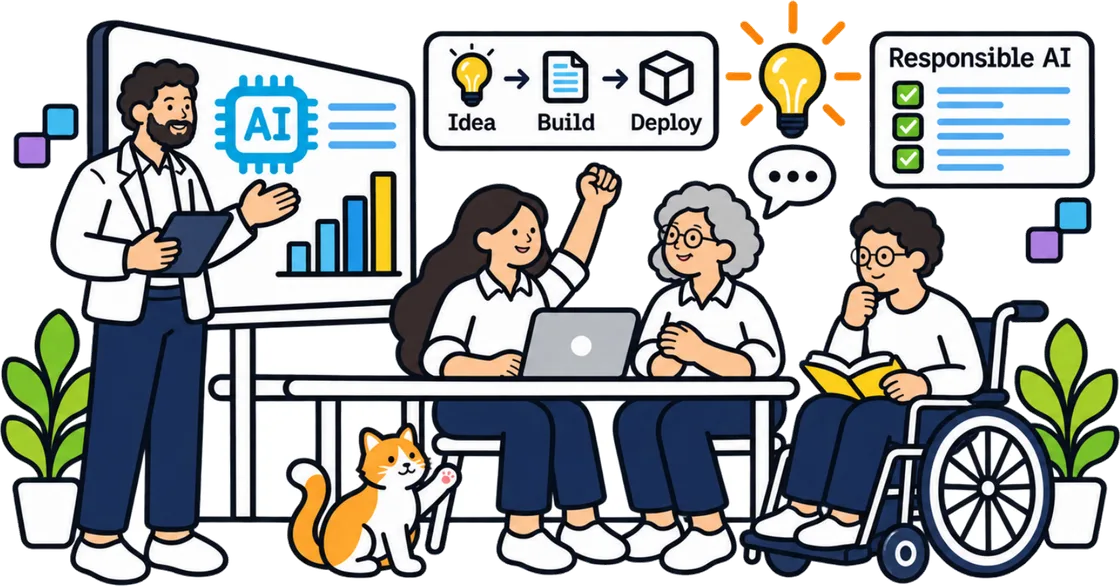
Output monitoring goes a step further. Keep a record of the prompts you used, the responses you received, and any edits you made. Over time, this log helps you spot patterns: maybe the model struggles with certain topics, or it tends to produce longer responses than you need. You can then adjust your prompts or switch to a different tool if the issues are persistent. Organisations that take this seriously often build a simple checklist for each review, covering points like factual accuracy, privacy compliance, and appropriateness of tone.
Consider access control and data boundaries
If multiple people in your team will use the same generative AI tool, you need to think about access control. Who can submit prompts? Who can see the history of prompts and responses? Some platforms allow you to set roles so that only certain users can view past conversations. This is important if your team handles sensitive information, because one person's prompt might contain data that another team member should not see.
Also, think about how the tool interacts with other systems. If you plan to connect the AI to a database or a customer relationship management system, check whether the integration exposes more data than necessary. The principle of least privilege applies here: give the AI access only to the data it needs for the task, not to your entire database. A well-designed tool will let you define these boundaries clearly.
UCC is a structured programme that helps professionals build a working generative AI application over two days, and part of that process involves learning to evaluate tools for privacy and reliability. The course emphasises practical steps like the ones described here, so participants leave with not just a prototype but also the confidence to choose the right tool for their organisation.
Plan for ongoing evaluation
Your first assessment of a generative AI tool should not be your last. Models get updated, policies change, and your own use cases evolve. Set a regular review cycle, perhaps every three or six months, to re-check the privacy policy and run your test prompts again. If the provider releases a new version of the model, test it before you upgrade in production. Sometimes a new version fixes old problems; sometimes it introduces new ones.
UCC also teaches participants how to set up a simple monitoring framework, so that even after the course ends, they can keep their AI applications safe and effective. The key is to treat evaluation as an ongoing habit rather than a one-off task.
By following these steps - starting with a risk assessment, checking privacy policies, evaluating transparency, testing for bias, setting up human oversight, managing access, and revisiting your choices - you can use generative AI tools with far more confidence. The technology is powerful, but it works best when you understand its limits and put sensible safeguards in place.